How to Future-Proof Your Home’s Electrical Infrastructure for the Next Decade
Many homeowners tend to consider their electrical system in a fragmented way: getting a new air conditioner, an EV charger, perhaps solar panels. However, the reality is that everything is interconnected through the switchboard and its capacity and conditions ultimately determine if these new additions will work well together or lead to system failures. Therefore, the best place to start planning for the future of home electrification is, in fact, the switchboard.
The Switchboard is the Bottleneck, Not the Wish List
You can buy an EV charger, a heat pump, or solar panel system without worrying about what’s behind that metal door. But eventually, all of those products tie back into the same panel. And that panel has a firm amp rating. A typical board might be rated at 63A or 100A single-phase. That number is how much current your home can draw at once, across every circuit, every appliance, every charger.
Add up an oven, ducted air conditioning, a couple of loads of washing, and an EV pulling current on an evening, and you can get uncomfortably close to that ceiling faster than most people realize. The switchboard doesn’t care how efficient your new gear is on paper. It singularly cares about simultaneous draw. That’s the number that decides whether a panel upgrade is optional or a must.
Start With a Load Demand Calculation, Not a Guess
Prior to making any of those decisions, I would advise that you hire a licensed electrician to run a formal load demand calculation for your entire home. This is an engineered assessment of what your home actually draws when things run together. Not the sum of every appliance’s rated wattage. It accounts for diversity, the fact that not everything runs full tilt all the time, and gives you a proper idea of what your board has as spare capacity on paper.
This gets skipped constantly because it feels like you’re spending a thousand dollars or so on something that’s not the actual device in your hand. In practice, it’s the cheapest part of the entire process and the one that stops you making mistakes that cost thousands. A load calculation done properly will tell you whether your existing board can absorb an EV charger and solar without modification, whether you need a sub-panel to spread the load, or whether the whole board needs replacing. Skipping it means finding out the hard way, usually after the charger’s already installed and nuisance-tripping every second night.
Ceramic Fuses and Other Signs Your Board is Already on Borrowed Time
Many switchboards still in use today were fitted many decades ago, and a lot of them still rely on ceramic fuses and not modern circuit breakers. Fuses aren’t an unsafe technology in themselves if they’re not faulty, but they’re increasingly difficult to acquire, they don’t give each circuit the individual protection that breakers do, and a previous owner “upgrading” a fuse to cope with a nuisance blow is a common and truly hazardous shortcut.
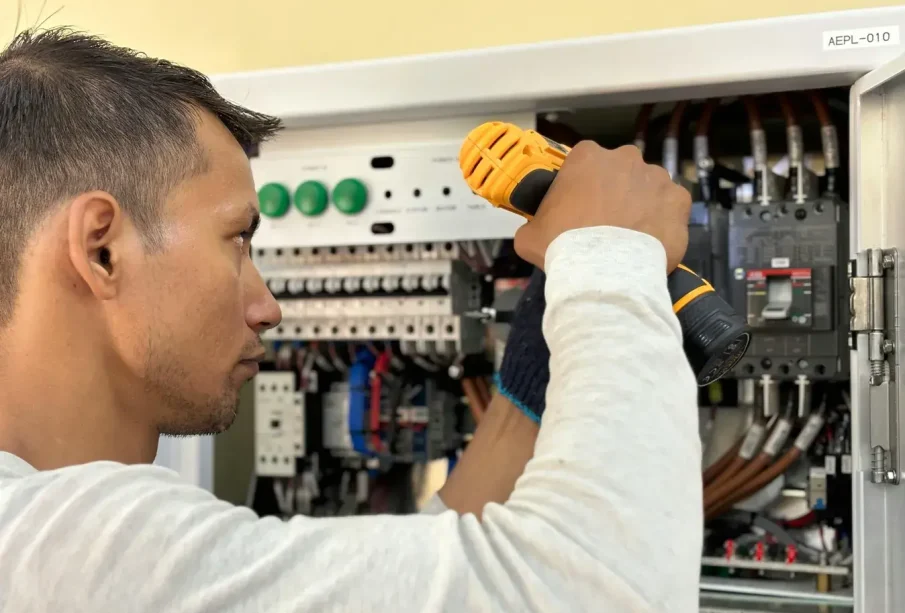
Years also physically take their toll, not merely electrically. Bus bars become corroded. Neutral connections from years of current cycling will burn and blacken. Lugs will work loose from thermal expansion and contraction, especially in a board that’s never been serviced. None of these issues reveal themselves if you just look at the amp rating on the panel door. They reveal themselves once an electrician has an open board and can see them first-hand, this is why a visual condition check is equally as important as a capacity check.
There are greater demands being placed on old boards by new appliances. Items like an induction cooktop or a heat pump dryer will draw sharp inrush current as they cycle on, and a spike of current like that could trip an already stressed oversized fuse or trigger a breaker that was not specified with that appliance in mind. Making sure the breaker is correctly sized to the actual appliance load is not a minor detail – it’s the difference between a board which functions for fifteen years without a hitch and one that an electric dryer will trip every other time it’s run.
EV Charging is the Load That Breaks Old Boards
Home EV charging has driven many more Melbourne homeowners to consider switchboard upgrades Melbourne over the last few years than any other cause, and it’s not hard to see why. A typical 7kW home charger already draws around 32A all on its lonesome, not accounting for anything else in the house running at the same time. Throw an oven, some ducted air con, and early-evening general lighting into the mix, and a 63A single phase board can easily reach or exceed its safe maximum most nights.
This is no longer a niche case either. Electric cars made up 18% of global car sales in 2023, up from 14% the year before (International Energy Agency). That sort of growth doesn’t happen by accident, and it means EV charging load has gone from being an almost insanely occasional consideration to a standard household one almost in the blink of an eye. If you’re planning to move to an EV in the next few years, even if you haven’t yet, it’s worth getting your board checked for surplus capacity sooner rather than later. The last thing you want is to find out your board can’t handle the charger at full speed after it’s already sitting in your garage.
This is exactly the kind of scenario where the right money spent in advance on a proper switchboard upgrade saves you two or three times its price. Your sparky can check your existing board against your known and future load, and either sign off on it or tell you how many wide-open-throttle kW you can afford, in what combination of phases, for what money.
Solar and Battery Storage Change the Switchboard’s Job
Solar and battery systems do not only increase load, but also generation. This ultimately affects the switchboard requirements. Rooftop solar transmits electricity back through the board during the daytime. This means that the breakers, isolators, and connection points must all safely handle backfeed current, instead of drawing power from the grid in one direction.
Battery storage further complicates this process, as the board now manages power coming in from the grid, in from the panels whilst simultaneously sending it out to storage, sometimes during the same hour. In many cases, the “repair” decision is silently converted into a “replace” decision. An old board might be able to manage solar backfeed on paper, however, it may lack the physical space or rated capacity for battery connection points down the track. Instead of modifying the same board twice within a few years, it is usually cheaper and overall better to replace it once with solar and storage both factored in, regardless of whether the battery is connected immediately or not.
The Cheap Upgrades People Skip
Two often-overlooked upgrades are RCD protection and whole-house surge protection. They’re relatively inexpensive during a switchboard upgrade and both provide protection for every device in a home. Retrofitting only a single circuit at a time is possible but an order of magnitude more expensive for the same protection.
RCDs protect people from electric shock. They instantly cut power if they detect current leaking to earth. Homes built roughly pre-1990 only have RCD protection, if at all, on power circuits, and no protection at all on lighting circuits.
Whole-home surge protection is the other one. Surges are the second-leading cause of breakdown in electronics after heat, reducing longevity on everything downstream. It’s cheap to install a surge protection device during a switchboard upgrade, and it protects everything including the EV charger and solar inverter you just spent thousands on. Skipping it to save a small amount up front is a strange trade-off when the equipment it protects is worth so much more.
Build For Fifteen Years, Not This Year
The most common error we see is not selecting the wrong board. It’s selecting the correct board for your current needs and not considering your future needs. A board that is the exact size of your current requirements, with no spare breaker slots, and no room for a future three-phase conversion, will require replacing as soon as your situation changes.
In this case, three-phase power is relevant. It is what high-demand loads such as fast EV charging or induction cooking with several elements operating simultaneously require to efficiently draw current, and it is not available in every house. If you have to convert later, and the board hasn’t been designed with that upgrade in mind, it’s almost certain that the modification will cost more than creating the provision during installation.
Extra capacity is dirt cheap when you build it in as part of a new install. It is incredibly expensive when you have to rip the board out that you had installed five years ago because it’s completely full.
This Isn’t a Job For a Weekend Project
Switchboard work includes live mains connections and often requires communicating with the network provider for isolation and metering. This work has to be performed by a licensed electrician, and once it’s finalized, the work must be approved and a compliance certificate issued. This is not just bureaucratic red tape. Both insurers and network providers depend on this documentation, and unlicensed work could invalidate your insurance or pose a real danger for everyone who interacts with the board after you do.
If your house is still wired for the previous century, and your switchboard is probably older than most of the devices in your home, the best step is often to have an assessment done before you add anything else.
It’s almost never that the switchboard itself causes a problem until something does trip or stop working, but it is the one part of the house that every other future upgrade will rely on. Get it designed adequately for future growth once, and every subsequent decade of electrical work will be as simple as your builder making another connection.