How to Choose the Right Fasteners for Permanent Outdoor Structures
Why fasteners are the most important decision in your build
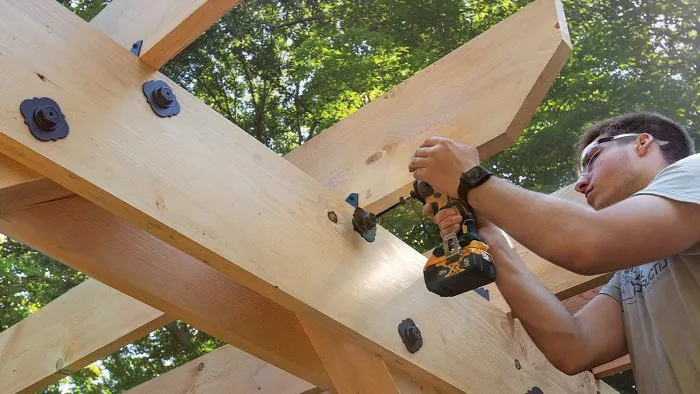
The majority of structural failures in outdoor builds don’t begin with the timber or the steel – they begin with the wrong hardware. You can build a pergola, deck, or fence post out of the most fabulous materials, and they will fail within five years if the fasteners weren’t selected for the conditions they’d actually experience. Getting this right is rarely about simply buying the most expensive fastener option, and instead is about understanding the forces your fasteners will face.
Start with your environment, not your materials
Before you make a purchase, you need to evaluate how corrosive your environment is. Contaminants like saltwater, industrial pollution, and sustained humidity can all cause metal to degrade more quickly.
Typically, zinc-plated fasteners are good enough for suburban inland builds in mild exposure. However, zinc plating is a very thin barrier coating, and as soon as that surface gets scratched during installation, the base metal is exposed. If you’re within a couple of km of coastal air, you’re going to find that it gets eaten alive and seizes up within a year.
For applications with high humidity and coastal salt air, marine-grade 316 stainless steel is the proper choice. 316 stainless contains molybdenum, which makes it more resistant to pitting caused by the chloride found in saltwater and de-icing solutions than 304 stainless. 316 stainless is roughly three to five times more expensive to procure, but breaking out a structural connection and replacing it is a lot more expensive.
Also, watch out for issues with galvanic corrosion – if you mix aluminum and steel fasteners in a wet environment, you will kick off an electrochemical corrosion reaction in both the aluminum and the steel. Either stick with one metal family throughout the build, or use isolation washers anywhere you can’t.
Match fastener strength to the actual loads
There are two strength values that you need to be familiar with. While they sound similar, they measure different things: tensile strength and shear strength.
Tensile strength is the capacity of a material or fastener to withstand a force pulling or tending to pull it apart, and shear strength is the opposing force that occurs in a parallel direction to the surface. In simpler terms: tensile strength is resistance to being pulled apart, and shear strength is resistance to being sheared apart.
For example, a deck ledger that is fastened to a house with lag screws has a significant shear demand – the screws are resisting a lateral force. If the deck were to pull away from the house, the ledger and the screws would be experiencing tensile stresses – they’re being pulled straight out.
So, standard wood screws are used where the design loads are likely to pull the fasteners straight out of the wood, whereas lag screws have the shear value needed where the design loads are parallel to the face of the board or beam.
When access is limited, the fastener has to do the whole job
When you need to secure two faces of metal together but can only reach one side, your typical fastener won’t do. That’s because “regular” nuts, bolts, and screws assume you can get at both sides of the joint. When connecting hollow-section metal framing, square tubing, or any post where the interior is sealed, that’s not possible – the type of fastener you rely on must change.
Structural Rivets are designed with this limitation in mind. Installed from one side, Rivets create a mechanical lock against the rear of the material without the need for rear access. The mandrel is pulled through the body, causing the body itself to deform and effectively clamp the materials between two bearing surfaces. If you expect this to be the final connection, choose a rivet with a retained mandrel. Rather than breaking off flush, the pin will lock inside the body after the riveting process. This substantially improves both vibration resistance and pull-out strength.
Vibration resistance is more important to a successful permanent installation than you might think. Fasteners in outdoor structures don’t just sit there – they’re subject to thousands of small lateral movements each year as the wind cycles. If the fastener is not built to maintain clamping force under dynamic load, the connection can work itself loose.
Account for movement in wood-to-metal connections
Wood is not a solid, unchanging block of material. It moves. It expands when moist, and it contracts when it dries. Metal, on the other hand, doesn’t move at the same rate. So the fastener is sitting between two materials that are constantly changing size at different rates.
A fastener that’s too rigid for this transition will have one of two things happen to it: it’ll eventually crack under the stress, or the fastener will hold and timber splits around it. Neither of which is good for a permanent structure.
Making the holes for the fastener larger than the fastener and putting in a clamping washer that allows for some movement, gives the joint the flexibility to account for that differential expansion, without compromising the connection. This isn’t about loosening the joint – it’s about giving the materials the room they need to move.
Grip range is non-negotiable
Each fastener is designed to clamp a specific grip range – that is, the combined thickness of material it cinches together. Use a fastener that’s too short for the sum of your thicknesses and it won’t create that clamping force necessary for a permanent joint. It may seem solid at first, but over time it’ll just come loose on you.
Measure the total stack of material before selecting fastener length. Also, add the thickness of any washers to your measurement. Choose a fastener whose grip range wraps around all of it.
This is one of the simplest checks to make and one of the most commonly skipped. All the right home repair tools and hardware are useless if the fastener sizes aren’t meant for the actual joint.